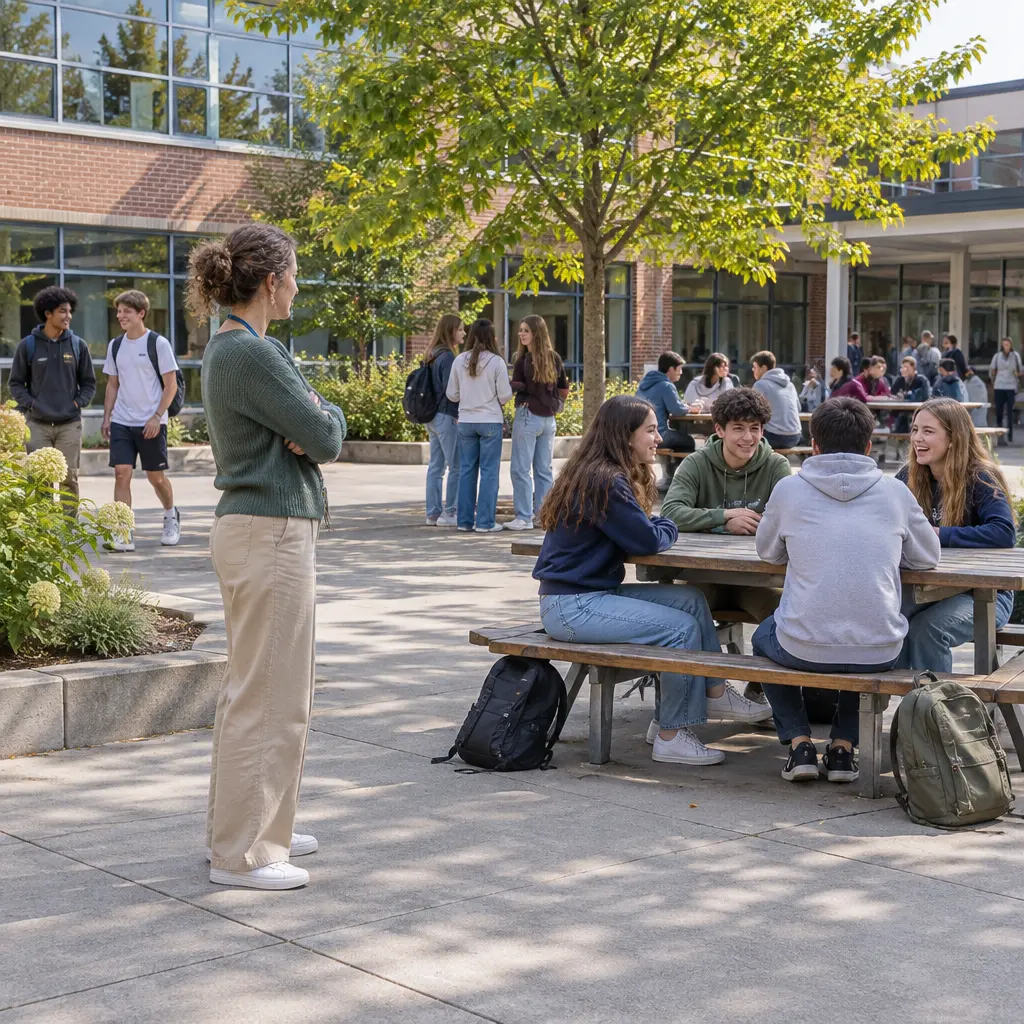
School culture fit is the match between a student’s needs and a school’s everyday social and learning environment—not merely its stated values or polished tour. To assess that fit, families should observe peer dynamics during lunch, recess, transitions, and other unstructured periods, then compare what they see with evidence on belonging, safety, and student support. This matters because the Centers for Disease Control and Prevention reports that students who feel connected to school are more likely to have better attendance and academic outcomes, while the National Center for Education Statistics’ 2021–22 School Crime Supplement found that about 19% of students ages 12–18 reported being bullied at school during the school year. A thoughtful visit therefore looks beyond facilities to interactions, routines, and how adults respond when social situations become difficult.
Observing Peer Dynamics Defines School Culture Fit
School culture fit is the degree to which a school’s social norms, relationships, expectations, and support systems align with a student’s temperament, identity, learning needs, and sense of safety. The National School Climate Center describes school climate through the quality and character of school life, including relationships, teaching and learning, institutional environment, and safety. In practice, culture fit is not a judgment that a school is universally “good” or “bad”; it is an assessment of whether its daily conditions help a particular student participate and thrive.
A campus tour often emphasizes classrooms, programs, and facilities, but those planned settings may not reveal how students treat one another when adults are less directive. Unstructured time—such as lunch, recess, passing periods, arrival, dismissal, and time before or after activities—offers a useful view of belonging, peer inclusion, conflict, and adult supervision. These moments should be interpreted alongside conversations with students and staff, school policies, and available climate data rather than treated as a stand-alone test.
Belonging and Peer Inclusion
Belonging means that students experience themselves as accepted, respected, and included members of the school community. During an observation, notice whether students can join games or conversations, whether groups are open or tightly closed, and whether peers make space for newcomers. Look for patterns rather than isolated moments: one student sitting alone does not establish exclusion, but repeated gatekeeping, mocking, or ignored requests may warrant questions.
The CDC’s Youth Risk Behavior Survey reports that in 2023, 77.0% of U.S. high school students said they felt close to people at school. That national figure provides context, not a target for judging an individual campus. Ask how the school measures belonging, how students who are new or socially isolated are supported, and whether students can identify trusted adults.
Safety, Conflict, and Adult Response
Peer dynamics include ordinary disagreement as well as exclusion, harassment, and bullying. Bullying is generally distinguished from a one-time conflict by repeated aggressive behavior and a real or perceived power imbalance. Observe how adults position themselves, whether they notice distress, and whether their interventions are calm, proportionate, and respectful. A school’s response to a difficult interaction can be more revealing than the fact that a disagreement occurred.
The NCES 2021–22 School Crime Supplement found that approximately 19% of students ages 12–18 reported being bullied at school during the school year. The figure is a national estimate and does not describe any specific school. Ask administrators how incidents are reported, documented, investigated, and followed up with students and families; also ask how the school protects students from retaliation and supports both those harmed and those who caused harm.
Unstructured-Time Observation Reveals School Culture Fit
Observing unstructured time means paying attention to the ordinary social settings in which students make choices, negotiate shared space, and interact with less formal direction. These observations can reveal whether school expectations are lived consistently or appear mainly during presentations and classroom visits. They cannot, by themselves, prove what a school is like every day: schedules, weather, special events, age differences, and the presence of visitors can all affect behavior.
A useful approach combines direct observation with context. Visit more than one setting if possible, ask permission to observe, avoid photographing or identifying children, and discuss what you noticed with school staff. Families can also ask whether the observed day was typical and whether they may speak with students or caregivers about their experiences.
Lunch and Recess: Informal Belonging
Lunch and recess show how students choose companions, share space, and handle entry into activities. Notice whether play is varied and accessible, whether students have options for quieter or less competitive activities, and whether supervision is visible without being unnecessarily controlling. For students with disabilities, sensory needs, or mobility differences, ask how activities and spaces are adapted so participation is practical rather than merely permitted.
The CDC identifies school connectedness as a protective factor associated with positive student outcomes. That connection is built through repeated relationships and experiences, not a single friendly greeting. Ask how staff help students who struggle to find a group and how the school responds when a child says they do not want to attend lunch or recess.
Transitions and Shared Spaces: Everyday Respect
Hallways, stairwells, bus lines, and classroom transitions reveal how students navigate crowding, time pressure, and shared rules. Watch for whether students move safely, whether older students dominate younger ones, and whether adults address problems consistently. Consider noise, pace, and sensory demands as well as social behavior, particularly for a student who may find crowded transitions difficult.
Transitions are brief, so avoid drawing strong conclusions from a single incident. Instead, note recurring cues: students making room for one another, staff greeting students by name, clear procedures, or repeated pushing and taunting. Ask what accommodations are available for students who need extra transition time or a quieter route.
Before and After School: Wider Community Signals
Arrival, dismissal, clubs, and extracurricular activities can show whether the school’s social environment extends beyond scheduled lessons. Observe how students are welcomed, how adults communicate with families, and whether activities appear accessible to students with different interests, abilities, and financial circumstances. If a student relies on transportation or after-school care, these routines are part of the school experience and deserve the same attention as classroom instruction.
Ask which activities have additional costs, how students learn about them, and what support is available for participation. A school may have a broad activity list but still face barriers involving fees, transport, scheduling, or social access. The relevant question is not simply what exists, but who can realistically take part.
Student Voice and School Climate Data Strengthen School Culture Fit
Direct observation becomes more reliable when paired with student voice and school climate data. The U.S. Department of Education’s National Center on Safe Supportive Learning Environments frames school climate through dimensions including safety, relationships, teaching and learning, and the institutional environment. These dimensions help families turn a general impression into specific questions about whether students feel safe, respected, and supported.
Ask whether the school conducts climate surveys, who participates, how often results are reviewed, and what changes followed the findings. Survey averages can conceal differences between grade levels or student groups, so request disaggregated results when available and appropriate. Schools may protect confidentiality by limiting the detail they can share, but they should be able to explain their process and priorities.
Student and Family Perspectives
Students and families can explain the context that a brief visit cannot capture. Ask students what happens when someone is left out, whom they would approach for help, and whether adults follow through. Ask families how the school communicates about peer conflict, how quickly concerns are addressed, and whether they feel listened to. Open-ended questions usually produce more useful information than asking whether everyone is “happy.”
Look for consistency across accounts, while recognizing that students may have different experiences within the same school. A confident student may thrive in a highly social environment that overwhelms another. The goal is to understand the range of experiences and determine whether the school can respond to the needs of the particular child.
Policies, Practices, and Follow-Through
Written policies describe intended practice; follow-through shows how that intention works in daily life. Review the school’s behavior, bullying prevention, inclusion, and student-support procedures, then ask who is responsible for implementation and how families receive updates. Useful evidence includes staff training, clear reporting channels, restorative or other response processes, and routine checks that determine whether a student feels safe after an incident.
Compare policy language with what you observed without expecting a school to disclose private student information. A credible response explains the process, timelines, and available supports while protecting confidentiality. If a school dismisses concerns, cannot describe how reports are handled, or treats student conflict as automatically harmless, seek clarification before deciding.
A Structured Visit Makes School Culture Fit Easier to Assess
A structured visit reduces the chance that an attractive campus or one memorable interaction will dominate the decision. Before visiting, identify the student’s priorities—for example, a calm lunch space, supportive adults, inclusive activities, or predictable transitions. During the visit, separate what you directly observed from what someone told you and from your own interpretation.
Use a Consistent Observation Checklist
A simple checklist makes comparisons between schools more useful. Record the setting, time, observed behavior, adult response, and questions that remain. Do not rate individual children or infer a whole-school pattern from one brief episode. The following points can guide observation:
- Can students join activities or conversations without repeated rejection?
- Do adults appear attentive and approachable in less structured settings?
- How are disagreements handled, and do students seem able to seek help?
- Are quiet spaces, accessible activities, and reasonable transition supports available?
- Do observed interactions align with the school’s stated expectations and policies?
Interpret Evidence Without Overgeneralizing
A strong decision distinguishes a one-time event from a repeated pattern and a schoolwide issue from a mismatch affecting one student. If something concerns you, ask a neutral follow-up question and, when possible, observe another setting or visit on another day. Consider the student’s own account, relevant support plans, and the school’s willingness to discuss practical accommodations.
For example, a prospective student who prefers quieter social settings may find a school with several supervised clubs, a calm lunch option, and an accessible trusted adult to be a better fit than a school whose social life centers on loud, competitive activities. The example does not mean one culture is superior; it shows why fit depends on the interaction between a student’s needs and the school’s actual routines.
Conclusion: Observe Daily Life Before Deciding on School Culture Fit
School culture fit is best understood through the combined evidence of peer inclusion, safety, adult response, student voice, and school climate practices. Tours provide useful information about facilities and programs, but unstructured time reveals how students experience shared spaces and relationships in everyday life. National findings—including the CDC’s 2023 school-connectedness measure and NCES’s 2021–22 bullying estimate—show why belonging and safety deserve attention, while also reminding families that national statistics cannot substitute for local evidence.
Plan visits around lunch, recess, transitions, or extracurricular activities; ask open-ended questions; review policies and climate information; and compare observations with the student’s needs. The most useful next step is to request a conversation with school staff about any specific concern and, where possible, hear from students and families. A careful, respectful look at ordinary school life can help families make a more informed decision about where a student is most likely to feel included and supported.
Sources: Centers for Disease Control and Prevention, School Connectedness Helps Students Thrive, https://www.cdc.gov/youth-behavior/school-connectedness/index.html; Centers for Disease Control and Prevention, Youth Risk Behavior Survey Data Summary & Trends Report: 2013–2023, https://www.cdc.gov/yrbs/dstr/index.html; National Center for Education Statistics, Student Reports of Bullying: Results From the 2022 School Crime Supplement to the National Crime Victimization Survey, https://nces.ed.gov/pubsearch/pubsinfo.asp?pubid=2024055; National School Climate Center, The 13 Dimensions of School Climate, https://schoolclimate.org/school-climate/; U.S. Department of Education, National Center on Safe Supportive Learning Environments, School Climate, https://safesupportivelearning.ed.gov/school-climate.