
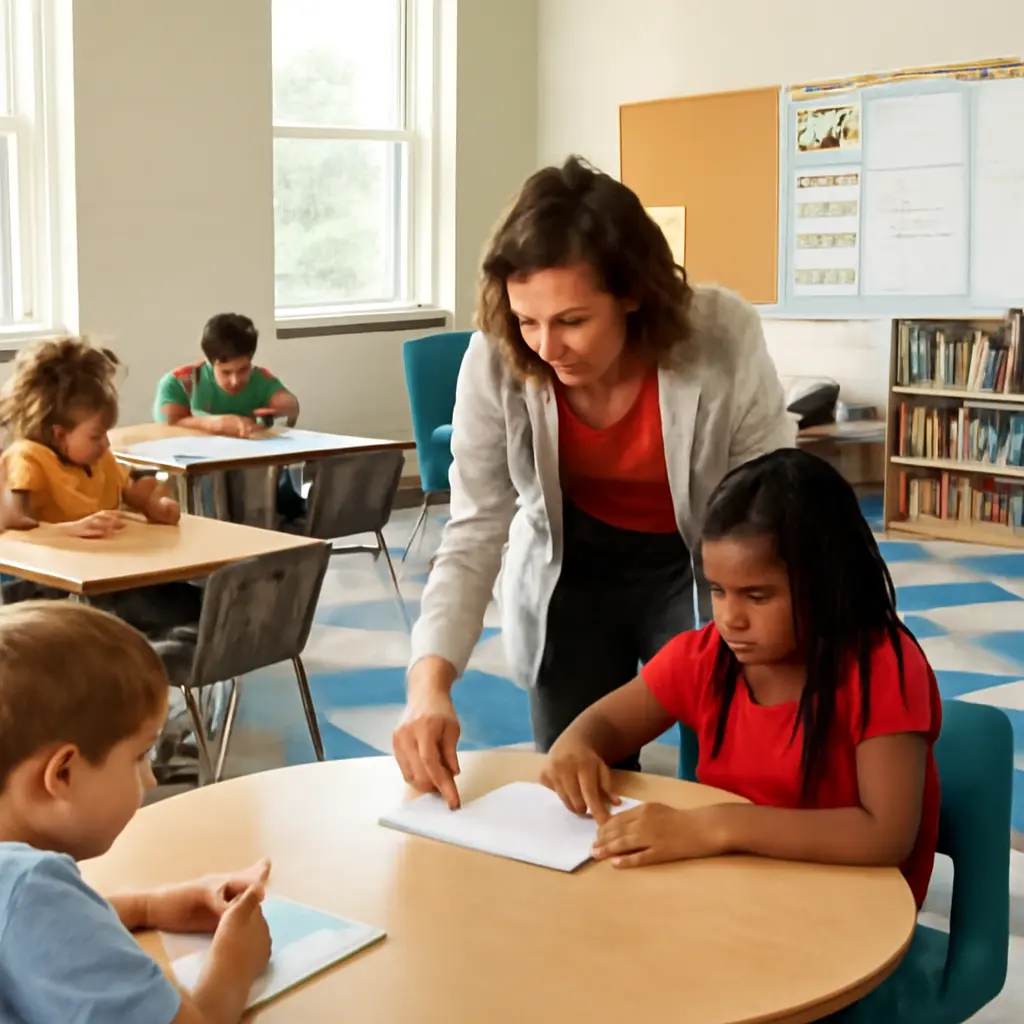
An adaptive classroom is a learning environment that adjusts instruction, materials, pace, or support to students’ differing needs while keeping shared learning goals in view. Inside one, teachers use observation, student work, and assessment data to decide who needs a new explanation, more practice, added challenge, or a different way to participate. The approach matters because students do not begin at the same point: the National Center for Education Statistics reported that 13% of U.S. public-school students received special education services under the Individuals with Disabilities Education Act in 2022–23. Adaptation is not a single technology or teaching method; it is a cycle of noticing, responding, and checking whether the response helped.
How adaptive instruction works inside a classroom
Adaptive instruction is a planned adjustment to teaching based on evidence about learners. The Institute of Education Sciences’ What Works Clearinghouse describes differentiated instruction in terms of responding to students’ readiness, interests, and learning needs; in practice, that can mean varying the route to a learning objective without lowering the objective itself. A teacher might explain a concept with a diagram and a worked example, then invite students to choose among guided practice, independent application, or an extension task.
The essential feature is the feedback loop: establish a goal, gather evidence, choose a response, and see what changes. Adaptation can be brief and ordinary—a clarifying question or a small-group reteach—or more formal, such as an accommodation written into an individualized education program. It is distinct from simply assigning students permanent “learning styles” or placing them into fixed ability groups. Students’ needs vary by subject, task, and moment.
Formative assessment: noticing what students understand
Formative assessment is the ongoing collection of evidence used to guide the next instructional move. A teacher may listen to partner talk, review a quick exit ticket, ask students to annotate a passage, or study a draft. These checks are most useful when they reveal a specific misconception or next step, rather than merely producing a score.
For example, if several students can calculate a fraction sum but cannot explain why a common denominator is needed, the teacher can pause the planned lesson and model the idea with visual fraction bars. If only one student is unsure, a short conference may be enough. The response is tied to observed evidence, not a guess about a student’s general ability.
Flexible grouping: changing the configuration, not the label
Flexible grouping means forming short-term pairs or small groups around a current learning purpose. A group might practice decoding, compare competing interpretations of a text, or work through a challenging problem with teacher guidance. Membership changes as the purpose and evidence change, allowing students to receive support in one area and take leadership in another.
A classroom may combine whole-class instruction, teacher-led groups, peer collaboration, and independent work in a single lesson. The structure is not inherently adaptive, however: it becomes adaptive when the grouping responds to a clear need and students can move on as their needs change. Teachers should also check that group labels do not become public rankings or restrict access to demanding work.
Scaffolds and accommodations: making access possible
A scaffold is temporary support that helps a learner complete a task they could not yet manage independently. Examples include a vocabulary preview, a sentence starter, a worked example, or a checklist. An accommodation changes how a student accesses or demonstrates learning—such as using text-to-speech, receiving extended time when appropriate, or answering orally—without necessarily changing the intended learning standard.
The National Center for Education Statistics’ 13% figure for students receiving IDEA services underscores why accessible instruction is a core classroom concern, not an occasional add-on. That population includes students with a wide range of disabilities and support plans. Teachers coordinate accommodations with families and specialists, while universal design choices—such as clear directions, readable materials, and multiple ways to engage—can reduce barriers for many learners.
How adaptive classrooms respond to different learning needs
Once teachers identify a need, the next decision is what kind of adaptation fits it. A learner who has not grasped a prerequisite may need explicit reteaching; a student who understands the core idea may need a more complex application; and a multilingual learner may benefit from language supports that preserve the intellectual challenge. These are related but distinct responses, and effective classrooms avoid treating every difference as a reason to give students separate curricula.
Targeted reteaching and additional practice
Targeted reteaching addresses a specific gap revealed by student work. Rather than repeating an entire lesson, a teacher isolates the difficult step, models it another way, and gives students a chance to try again with feedback. In mathematics, that could mean using a number line to revisit negative values; in writing, it could mean examining how evidence supports a claim.
The U.S. Department of Education’s National Assessment of Educational Progress provides a wider reason to attend to evidence of unfinished learning: its 2024 results showed that average reading scores for fourth- and eighth-graders declined compared with 2022, while mathematics scores were largely unchanged. National averages do not diagnose an individual classroom, but they reinforce the value of checking what students can do and responding with focused instruction rather than assuming a lesson has been mastered because it was taught.
Extension and enrichment for students ready to go further
Enrichment extends learning through greater depth, complexity, or independence—not simply more of the same questions. A student who has mastered a science concept might compare models, design an investigation, or explain how the idea applies to a new context. In literature, a student might analyze how two authors create contrasting points of view.
An adaptive classroom protects time for this work instead of requiring advanced learners to wait until everyone finishes identical practice. The teacher can offer choice within clear criteria, ensuring that extensions remain connected to the learning goal and produce meaningful evidence of understanding.
Language supports and culturally responsive teaching
Language supports make subject learning understandable while students develop academic English or learn through another language. Teachers may preteach essential terms, pair spoken explanations with images, provide discussion frames, or allow students to rehearse ideas with a partner before writing. These supports help students participate in grade-level thinking rather than substituting simpler thinking for language access.
Culturally responsive teaching also asks educators to connect instruction with students’ knowledge, identities, and experiences without assuming that any student represents an entire culture. The National Academies’ research on English learners emphasizes the importance of meaningful access to content and language development together. In classroom terms, this means learning about students’ strengths and using them as resources, while maintaining high expectations and checking whether each support is actually useful.
Technology in an adaptive classroom: useful tool, not the teacher
Adaptive learning technology uses student responses to recommend or sequence practice, provide feedback, or flag areas that may need attention. Digital tools can make it easier to offer multiple reading levels, speech-to-text, immediate practice, and progress summaries. But a platform’s recommendation is only one source of evidence; it cannot reliably interpret every reason behind an answer or replace a teacher’s knowledge of a student.
What learning platforms can and cannot personalize
A platform can adjust the next question based on prior answers or let students revisit material at their own pace. This may be helpful for structured practice, especially when teachers review the resulting information and use it to plan. Technology is less suited to judging complex reasoning, understanding a student’s circumstances, or deciding whether a learner needs encouragement, a different explanation, or a conversation.
The U.S. Department of Education’s 2024 National Educational Technology Plan frames effective technology use around a digital divide in access, design, and use. That distinction matters: providing a device does not ensure that students have reliable connectivity, accessible software, or instruction that uses the tool well. Schools should evaluate whether technology improves access and learning, not count screen time as proof of personalization.
Privacy, bias, and responsible use of student data
Adaptive systems may collect performance, usage, or personal information, so schools need clear rules for what is gathered, who can access it, how long it is retained, and how families are informed. The U.S. Department of Education’s Privacy Technical Assistance Center explains that student data must be handled in accordance with applicable privacy requirements, including the Family Educational Rights and Privacy Act.
Automated recommendations can also reflect limitations in the data or design behind them. A low score might signal an unfamiliar format, a language barrier, or a technical problem rather than a lack of understanding. Teachers should treat automated flags as prompts for investigation, offer students ways to explain their thinking, and avoid allowing opaque systems to make high-stakes decisions on their own.
A real-world example: one lesson, several routes to the same goal
Imagine a fifth-grade class working toward a shared goal: using evidence to explain how a character changes. The teacher begins with a short passage and asks students to underline a moment that reveals the character’s thinking. An exit response shows three patterns: some students identify relevant evidence and explain it; some choose a detail but do not connect it to a claim; others need help understanding key vocabulary in the passage.
The following day, the teacher offers a brief whole-class model of connecting evidence to reasoning. Students who need language access preview vocabulary and discuss the passage with a partner; a teacher-led group practices explaining the link between a quotation and a claim; students ready to extend compare the character’s actions across two scenes. Everyone works toward the same core objective, but the supports and depth vary. A later written response checks whether the adjustments helped.
This example illustrates the classroom’s central rhythm: shared goals, varied routes, and follow-up evidence. It also shows why personalization is not synonymous with students working alone on separate screens. The teacher remains responsible for interpreting evidence, protecting belonging, and deciding what happens next.
What makes adaptation sustainable for teachers and students
Responsive teaching requires preparation, time, and coordination. Teachers cannot make every lesson individually from scratch, so sustainable systems use common learning goals, reusable scaffolds, collaboration with specialists, and a manageable set of assessment checks. A school can support the work through planning time, accessible materials, professional learning, and clear processes for communicating with families.
- Start with a precise learning goal and decide what evidence would show progress.
- Use brief checks that reveal thinking, not just task completion.
- Choose a response proportionate to the need: clarify, scaffold, reteach, extend, or provide an accommodation.
- Review whether students improved and adjust again when needed.
- Protect student dignity by avoiding public ranking and treating support as a normal part of learning.
Students also need a voice in the process. Asking what helped, what was confusing, and what challenge they are ready for can reveal information that a quiz misses. When students understand the goal and can reflect on their progress, adaptation is more likely to build agency rather than make them feel that decisions are being made about them without their participation.
Conclusion: an adaptive classroom is a responsive classroom
An adaptive classroom uses formative assessment, flexible grouping, scaffolds, accommodations, enrichment, and—where appropriate—technology to respond to students as learners, not as fixed categories. The most important work happens in the connection between evidence and action: teachers notice what students understand, choose a useful next step, and check whether it worked. National data on special education services and recent NAEP results make clear that varied needs and unfinished learning are part of the educational landscape, but adaptation is valuable for every student.
For educators and school leaders, a practical next step is to examine one upcoming lesson: name the shared objective, identify a quick way to see what students know, and prepare one support and one extension. Then ask students what helped them learn. Those small, evidence-informed decisions are how a classroom becomes genuinely responsive—without losing its sense of community or its high expectations.
Sources: National Center for Education Statistics, Students With Disabilities, Condition of Education, 2024, https://nces.ed.gov/programs/coe/indicator/cgg; Institute of Education Sciences, What Works Clearinghouse, Differentiated Instruction: A Guide for Teachers, https://ies.ed.gov/ncee/wwc/PracticeGuide/14; National Center for Education Statistics, The Nation’s Report Card: 2024 Mathematics and Reading Results, https://www.nationsreportcard.gov/reports/reading/2024/g4_8/; U.S. Department of Education, 2024 National Educational Technology Plan, https://tech.ed.gov/netp/; U.S. Department of Education, Privacy Technical Assistance Center, FERPA, https://studentprivacy.ed.gov/ferpa; National Academies of Sciences, Engineering, and Medicine, Promoting the Educational Success of Children and Youth Learning English: Promising Futures, 2017, https://doi.org/10.17226/24677.


