
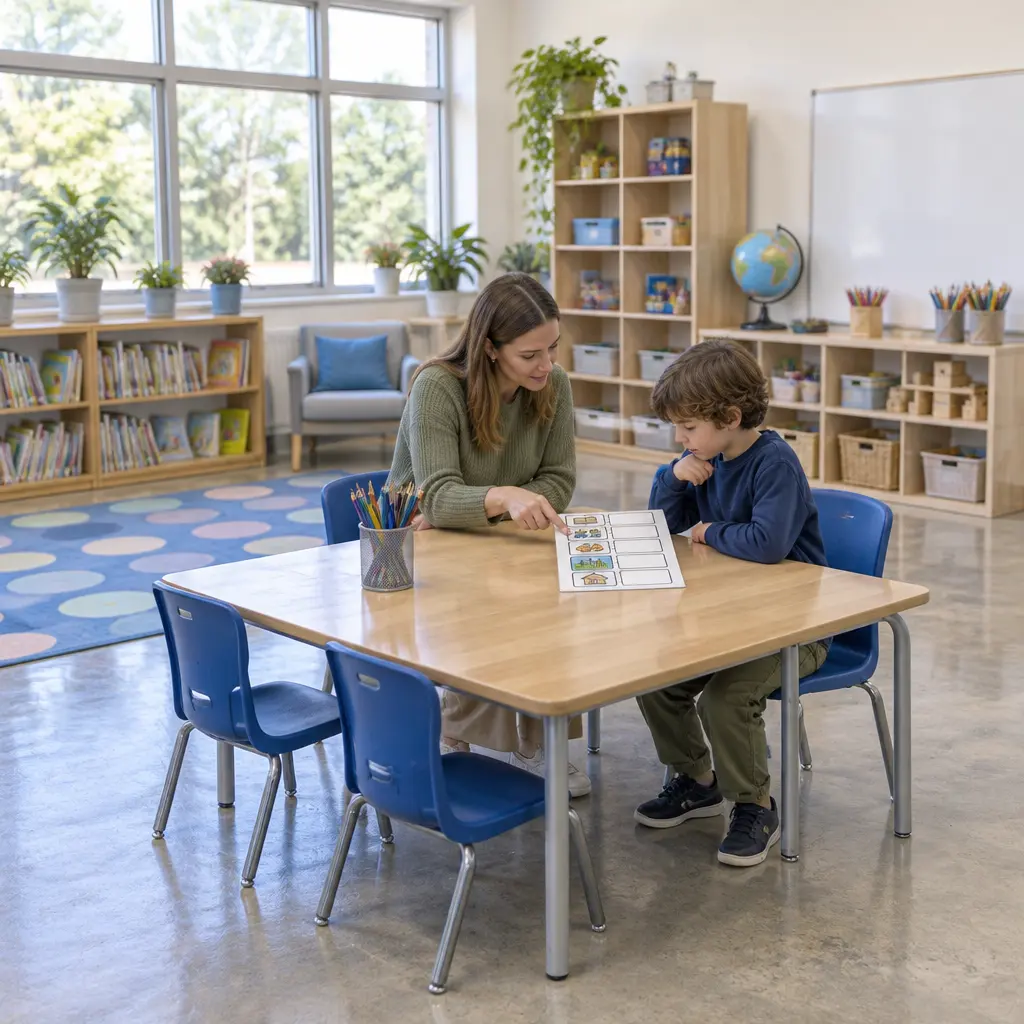
Neurodivergent learners are students whose ways of thinking, communicating, sensing, or processing information differ from what schools typically expect; the term commonly includes autistic students, students with ADHD, dyslexia, and other learning differences, though individual preferences vary. Individualized support strategies adapt instruction, environments, and assessment to each learner’s strengths and needs rather than relying on a single approach. This matters at scale: the U.S. Centers for Disease Control and Prevention estimates that about 1 in 31 eight-year-old children were identified with autism in 2022, while the National Center for Education Statistics reports that 7.5 million U.S. students ages 3–21 received services under the Individuals with Disabilities Education Act in 2022–23. Effective support combines learner-informed planning, accessible instruction, sensory and executive-function supports, and ongoing progress checks.
Individualized Support Strategies Improve Instruction for Neurodivergent Learners
Individualized instruction is the intentional adjustment of teaching and learning conditions in response to a student’s documented or expressed needs, strengths, interests, and goals. It is not a diagnosis-based package: two students with the same diagnosis may need different supports, and a student’s needs can change across subjects, settings, and time. The aim is access to meaningful learning and participation, not making every learner perform or communicate in the same way.
In U.S. public schools, formal supports may be described in an Individualized Education Program (IEP) or, where applicable, a Section 504 plan. The U.S. Department of Education explains that an IEP sets out a student’s special education, related services, and measurable goals. These plans provide a legal framework, while day-to-day instructional decisions still benefit from collaboration with the learner and family. A useful support plan links a specific barrier to a practical adjustment and a way to check whether that adjustment helps.
Learner-Informed Planning Defines Individualized Support Strategies
Learner-informed planning is the process of identifying what a student is trying to learn, what is getting in the way, and which adjustments can improve access without unnecessarily lowering expectations. The National Center for Learning Disabilities’ Universal Design for Learning framework emphasizes anticipating learner variability and offering multiple means of engagement, representation, and action or expression. Individualization complements that proactive design: universal options make instruction more accessible to everyone, while targeted supports address needs that remain.
A practical plan draws on student voice, classroom observation, family knowledge, work samples, and relevant professional assessments. It specifies the learning goal, the support, the context in which it applies, and how the team will evaluate its usefulness. Rather than assuming that a label predicts a need, educators can ask whether a student benefits from written directions, movement breaks, assistive technology, extra processing time, or a quieter work area—and then monitor the outcome.
Strengths-Based Profiles and Student Voice
A strengths-based learner profile describes interests, effective strategies, communication preferences, skills, and support needs together. For example, a student who finds open-ended writing difficult may explain sophisticated ideas verbally or through diagrams. Offering a choice of ways to plan or demonstrate understanding can reveal knowledge that a single format might obscure. Student voice is especially important because an accommodation that appears helpful to an adult may feel distracting, stigmatizing, or impractical to the learner.
The National Center for Education Statistics reported that 7.5 million students ages 3–21 received services under IDEA in 2022–23, representing about 15% of public-school enrollment. That broad population includes many different profiles, reinforcing why a single intervention cannot serve as a reliable substitute for individualized planning.
Collaborative Goals and Progress Monitoring
Progress monitoring means regularly collecting evidence about whether instruction and supports are advancing a defined goal. Measures might include accuracy, task completion, independent use of a strategy, participation, or the learner’s own account of effort and comfort. Teams can review a baseline, set a realistic target, and adjust the approach when evidence shows limited benefit. This is more informative than judging a support by whether a student appears compliant or quiet.
For instance, if a student misses multistep directions, a teacher can provide a short written checklist and check whether the student completes more steps independently over several weeks. If performance does not improve, the team can investigate other causes—such as unclear language, working-memory demands, anxiety, or insufficient teaching—rather than simply repeating the same prompt.
Accessible Instructional Design Reduces Learning Barriers
Accessible instructional design presents essential content in ways learners can perceive, understand, and use, while preserving the intended learning objective. The CAST Universal Design for Learning Guidelines organize this work around engagement, representation, and action and expression. Examples include pairing speech with written directions, previewing unfamiliar vocabulary, offering structured choices, and allowing students to show understanding through an appropriate range of formats.
These options are not a reason to dilute academic content. They help separate the skill being assessed from unrelated obstacles. If the goal is to explain a scientific process, for example, a student may be able to demonstrate that understanding through a labeled diagram or oral explanation even when handwriting or spelling is not the target skill.
Clear Structure, Predictability, and Explicit Teaching
Structured instruction makes routines, expectations, and task sequences visible. Teachers can post lesson agendas, break large assignments into smaller steps, model examples, and signal transitions in advance. Explicit teaching—demonstrating a skill, guided practice, feedback, and opportunities for independent practice—can reduce ambiguity for students who find implicit rules or open-ended directions difficult.
Consider a research assignment with several stages. A teacher might provide a checklist for selecting a question, finding sources, taking notes, drafting, and revising; show a completed example; and schedule brief check-ins. The student still engages with the full assignment, but the process is easier to navigate and monitor.
Flexible Materials and Ways to Demonstrate Learning
Flexible materials offer more than one route into the same content. Options can include text-to-speech, audio or digital text, captioned video, diagrams, manipulatives, speech-to-text, and graphic organizers. A student who has dyslexia may use text-to-speech to access grade-level subject matter while receiving separate, evidence-informed instruction in reading skills. A student with motor or writing-related barriers may use speech-to-text when composing is the learning target.
The National Center for Education Evaluation and Regional Assistance’s practice guide on students struggling with mathematics recommends systematic instruction, mathematical language, concrete and semi-concrete representations, and timed activities only when they are appropriate to the learner and purpose. The broader lesson is to choose tools based on the task and student—not on assumptions about a diagnosis.
Sensory and Executive-Function Supports Improve Participation
Sensory supports address how a student experiences sound, light, touch, movement, and other features of the learning environment. Executive-function supports help with planning, starting, organizing, remembering, and completing tasks. These areas overlap: a noisy room can make attention and working memory demands harder, while unclear task sequences can increase stress. Supports should be individualized and evaluated for their impact on access and learning.
The CDC’s autism monitoring network estimated that 1 in 31 eight-year-old children across its surveillance sites were identified with autism in 2022. This estimate describes identification in participating U.S. communities, not the needs or abilities of every autistic student. It underscores the importance of having flexible, respectful support systems rather than assuming a uniform classroom profile.
Sensory-Aware Classroom Adjustments
Sensory-aware adjustments modify environmental demands so a learner can participate more comfortably. Depending on the student, these may include access to a quieter work location, advance warning of loud events, seating choices, reduced visual clutter, movement opportunities, or permission to use suitable ear protection during independent work. The student should help determine whether a strategy is useful, and educators should ensure it does not exclude the learner from instruction or peer interaction.
For example, a student who becomes overwhelmed during a noisy group activity might receive a clear role, written instructions, and access to a quieter nearby space for part of the task. The purpose is not to remove all sensory input or avoid learning; it is to make participation manageable while preserving the learning objective.
Planning, Organization, and Task Initiation
Executive-function supports externalize steps that a learner might otherwise have to hold in memory. Useful strategies include visual schedules, timers, assignment chunking, color-coded materials, checklists, calendar reminders, and brief teacher check-ins. For ADHD in particular, a clear start cue and shorter work intervals may support task initiation, but the format should be adapted to the student’s age, preferences, and classroom context.
A student who forgets to submit completed work, for example, might use a consistent end-of-class routine: check the assignment list, place work in a labeled folder, and confirm submission through the school’s learning platform. Tracking whether missing submissions decrease helps the team determine whether the routine addresses the actual barrier.
Positive Relationships and Responsive Assessment Sustain Individualized Support
Individualized strategies work best within relationships that treat neurodivergent learners with dignity and presume competence. Support should increase access, communication, autonomy, and meaningful participation—not prioritize masking, silence, or conformity for its own sake. Educators can explain the purpose of accommodations, invite feedback, and protect students’ privacy when coordinating support.
Assessment should likewise distinguish between the learning objective and the format used to measure it. The U.S. Department of Education’s IDEA guidance requires an IEP to include measurable annual goals and explain how progress will be measured and reported. In classroom practice, teachers can also use low-stakes checks, oral responses, projects, written work, or demonstrations, selecting formats that provide valid evidence of the target skill.
Accommodations, Modifications, and Assistive Technology
An accommodation changes how a student accesses instruction or demonstrates learning without changing the fundamental learning expectation; a modification changes what the student is expected to learn. Examples of accommodations include extended time when speed is not the skill being assessed, accessible digital text, or a reduced-distraction setting. Assistive technology can include text-to-speech, speech-to-text, alternative keyboards, or communication tools. Teams should make clear which category a support falls into and confirm that the tool is available when needed.
A real-world classroom example is a student who understands grade-level history but reads slowly. Providing digital text with text-to-speech may allow the student to engage with the same content and demonstrate historical understanding, while reading instruction continues separately. If the assessment is specifically measuring decoding, however, using text-to-speech may change what the assessment measures; the team must match the support to the goal.
Reviewing Supports and Avoiding One-Size-Fits-All Practice
A responsive support plan is reviewed when a learner’s performance, environment, or preferences change. Teams can ask whether the support is consistently available, whether the student uses it voluntarily, whether it improves access or outcomes, and whether unintended barriers have emerged. A support that works in a quiet classroom may not work in a laboratory, cafeteria, or online lesson.
One common mistake is to equate individualized support with lowering expectations. Another is to provide a tool without teaching the student how or when to use it. Effective practice pairs appropriate expectations with explicit instruction, accessible conditions, and opportunities for the learner to build self-advocacy and independence.
Conclusion: Individualized Support Strategies Make Learning More Accessible
Individualized support strategies begin with learner-informed planning, use accessible instructional design, address sensory and executive-function barriers, and rely on positive relationships and responsive assessment. The evidence and guidance from the CDC, NCES, CAST, and the U.S. Department of Education point to both the scale of learner variability and the value of structured, measurable support. No single accommodation works for every student; the strongest approach connects a specific learning barrier to a practical strategy and checks whether it helps.
Educators and families can start by asking the learner what supports help, identifying one or two barriers that affect participation, and tracking a meaningful outcome over time. For further action, review the student’s IEP or 504 plan with the school team, explore CAST’s Universal Design for Learning Guidelines, and consult qualified specialists when assessment or assistive technology guidance is needed.
Sources: Centers for Disease Control and Prevention, “Autism Prevalence Higher, According to Data from 11 ADDM Communities,” 2025, https://www.cdc.gov/media/releases/2025/autism-prevalence-higher.html; National Center for Education Statistics, “Students With Disabilities,” Condition of Education, 2024, https://nces.ed.gov/programs/coe/indicator/cgg; U.S. Department of Education, “Sec. 300.320 Definition of individualized education program,” Individuals with Disabilities Education Act, https://sites.ed.gov/idea/regs/b/d/300.320; CAST, Universal Design for Learning Guidelines, https://udlguidelines.cast.org/; National Center for Education Evaluation and Regional Assistance, Assisting Students Struggling with Mathematics: Intervention in the Elementary Grades, 2021, https://ies.ed.gov/ncee/wwc/PracticeGuide/26.


