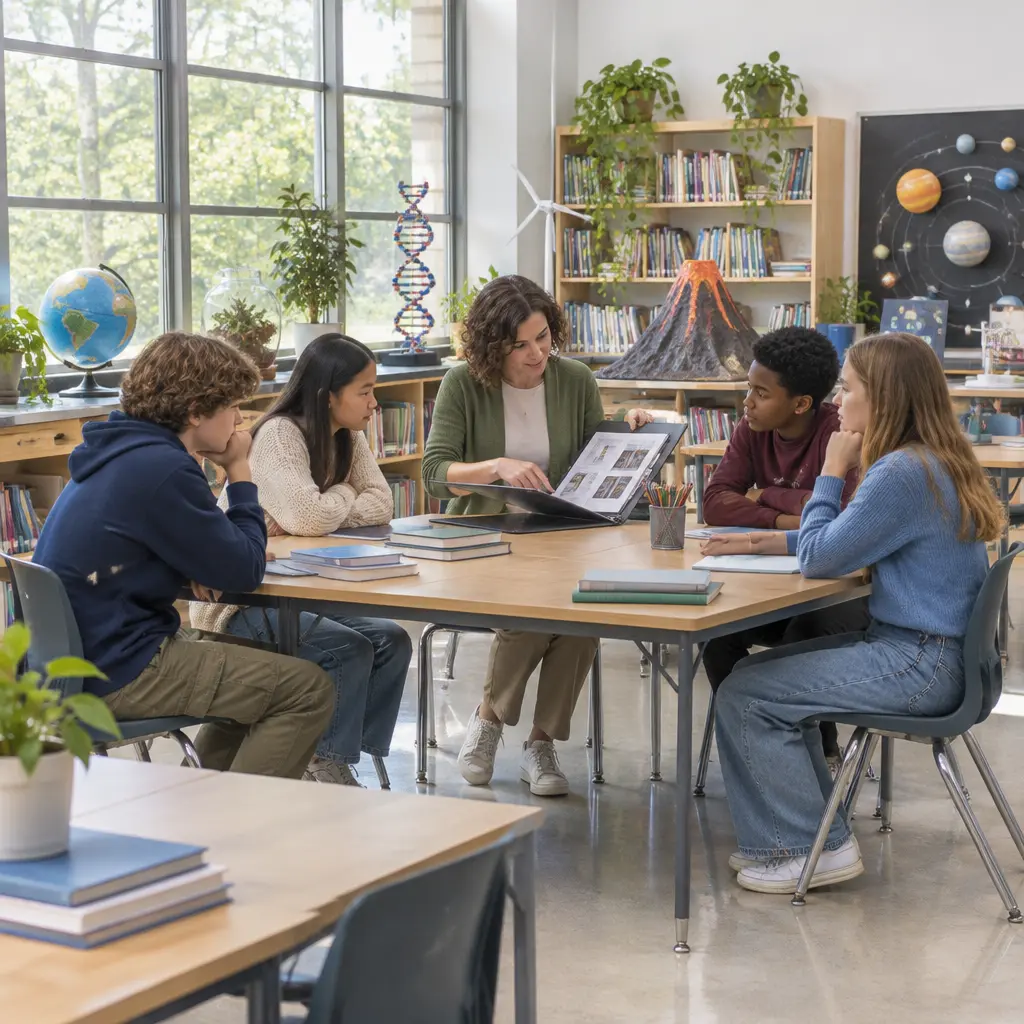
Student-centered curriculum design organizes learning around students’ interests, strengths, needs, and goals rather than relying on a single, identical route for everyone. It does not mean abandoning shared academic standards: it means offering purposeful choices in topics, activities, pace, and ways to demonstrate learning while keeping clear expectations. Research reviews associate well-designed personalized learning with positive academic outcomes, though results depend on implementation and evidence quality. This guide explains what student-centered curriculum design means, how interest- and strength-based learning paths work, which teaching practices support them, and how schools can assess and improve their impact.
Student-Centered Curriculum Design: Meaning and Core Attributes
Student-centered curriculum design is an approach to planning instruction in which students’ learning needs and agency shape meaningful parts of the curriculum. The term covers related practices—including personalized learning, differentiated instruction, inquiry-based learning, and project-based learning—but these approaches are not interchangeable. A curriculum can offer differentiated tasks without giving students substantial choice, while a student-centered design intentionally connects learning goals with students’ interests, strengths, and developing independence.
The Organisation for Economic Co-operation and Development (OECD) describes student agency as the capacity to set goals, reflect, and act responsibly to effect change. This framing is useful because it distinguishes student-centered learning from simply making lessons entertaining: students participate in decisions, but educators remain responsible for curriculum coherence, subject knowledge, accessibility, and evidence of learning. The learning path is the route a student takes toward defined outcomes—not permission to omit essential learning.
Personalized Learning Paths
A personalized learning path is a structured sequence of learning experiences adapted to a student’s current knowledge, goals, progress, and appropriate choices. It may adjust the order, pace, practice, or level of support while preserving common learning outcomes. For example, students studying ecosystems might choose a local habitat, a school garden, or a marine environment as the context for applying shared concepts such as food webs and energy transfer.
Personalization works best when teachers use frequent evidence—such as a short diagnostic task, student conference, or draft—to decide what comes next. The U.S. Department of Education’s National Education Technology Plan emphasizes using technology to expand access to engaging, empowering learning experiences, but devices alone do not personalize instruction. The key is the instructional response: a teacher interprets evidence and provides a relevant next step.
Differentiation and Flexible Access
Differentiated instruction adjusts content access, learning processes, or final products in response to learners’ readiness, interests, and learning profiles. Carol Ann Tomlinson, a leading scholar of differentiation, defines the approach through teachers’ proactive adaptation of instruction to student variation. In practice, students might explore the same scientific principle through different reading levels, hands-on investigations, or forms of explanation.
Differentiation is not a fixed label or a permanent track. Flexible grouping, accessible materials, and multiple ways to engage help students work toward challenging goals without assuming that one format suits everyone. The National Center for Education Statistics reported that 7.5 million students ages 3–21, or 15 percent of public-school students, received services under the Individuals with Disabilities Education Act in 2022–23. That figure underscores why accessible options and individualized supports must be part of curriculum planning, not afterthoughts.
Inquiry- and Project-Based Learning
Inquiry-based learning begins with questions, investigation, and evidence-based explanation. Project-based learning organizes a sustained inquiry around a meaningful problem or challenge, often culminating in a product or presentation. Both can connect required subject knowledge with student interests, provided projects are carefully designed to teach and assess specific concepts rather than reward presentation skills alone.
In a project about local water quality, for example, students could select a nearby stream, research relevant pollutants, analyze sample data, and communicate findings to the community. The context provides choice, while shared criteria ensure that every student practices scientific reasoning and interprets evidence. A 2021 review by the George Lucas Educational Foundation’s Edutopia summarizes evidence and implementation guidance for project-based learning; as with any instructional model, outcomes depend on quality, subject, and student support.
Student Interests and Strengths Shape Learning Paths
Interests and strengths are useful starting points for engagement, not limits on what students should learn. An interest is a topic, activity, or question that attracts a learner’s attention; a strength is a demonstrated or developing capability, such as explaining patterns, designing models, collaborating, or revising work. Teachers can use both to make required content meaningful while continuing to build skills that students have not yet mastered.
The National Survey of Student Engagement has long examined how participation, educational experiences, and institutional practices relate to student learning in higher education. In K–12 settings, the Gallup Student Poll has measured factors including engagement, hope, and well-being. These measures are not proof that interest-based curriculum alone causes achievement gains, but they highlight the importance of attending to learners’ experiences alongside test results. Schools should combine student voice with classroom evidence and avoid treating a survey response as a complete picture of a learner.
Discovering Interests Responsibly
Interest discovery is the ongoing process of learning what questions, settings, and activities help a student engage. Teachers can use brief interviews, choice boards, reading or media selections, reflection journals, and observation during collaborative tasks. Questions such as “What would you like to understand better?” or “Which part of this task made you want to keep going?” can reveal interests that a formal survey might miss.
Interests change with experience and opportunity. A student who has never encountered engineering, poetry, or a particular historical perspective cannot be expected to choose it in advance. Educators should therefore offer broad, culturally responsive options and introduce unfamiliar topics, rather than narrowing opportunities based on assumptions about gender, background, disability, or past performance.
Identifying and Developing Strengths
Strength identification draws on multiple forms of evidence: student work, formative assessments, observations, self-reflection, and feedback from families or specialists. A strength should be treated as an asset to develop, not a fixed identity. A student who explains ideas clearly in conversation, for instance, can use that capacity to build academic vocabulary and then practice communicating the same reasoning in writing.
This approach aligns with Universal Design for Learning (UDL), a framework developed by CAST that recommends multiple means of engagement, representation, and action and expression. UDL encourages educators to anticipate learner variability while preserving the intended learning goal. It does not require a separate lesson for every student; instead, it supports flexible routes that remove unnecessary barriers.
Choice With Clear Boundaries
Productive choice gives students meaningful decisions within clear academic boundaries. A teacher might let students choose whether to present a claim through a written essay, recorded explanation, or live presentation, while assessing all formats against the same standards for evidence, reasoning, and accuracy. This balances agency with fairness and makes expectations visible.
Too much unstructured choice can overwhelm learners, especially when they are still developing planning and self-regulation skills. A small set of high-quality options, exemplars, milestones, and check-ins helps students make informed decisions. Choice should expand access to the learning goal, not lower its rigor.
Designing and Supporting Individual Learning Paths
A practical student-centered curriculum connects three elements: shared outcomes, flexible learning experiences, and dependable evidence of progress. Teachers begin by identifying what all students should know and be able to do, then plan multiple ways to engage with the material and demonstrate understanding. This keeps individualized routes aligned with grade-level expectations and helps educators identify who needs additional challenge or support.
Start With Outcomes and Evidence
Begin with a concise learning target and success criteria. A unit on persuasive writing might require students to develop a claim, select relevant evidence, address a counterargument, and revise for clarity. Once those outcomes are explicit, a teacher can offer varied topics, source materials, scaffolds, and presentation formats without losing sight of what learning must be assessed.
Use diagnostic checks before instruction and formative checks during it. These can include exit tickets, annotated drafts, short conferences, quizzes, or demonstrations. The Institute of Education Sciences’ What Works Clearinghouse provides evidence reviews and practice guides that help educators examine whether instructional strategies are supported by research, rather than relying only on novelty or anecdote.
Co-Plan Goals and Milestones
Co-planning means teachers share appropriate decisions with students, such as selecting a topic, setting a short-term goal, or choosing a feedback routine. The teacher still ensures that goals are realistic, curriculum-aligned, and accessible. Students can track progress with a portfolio, checklist, or learning log and periodically explain what they have learned and what they plan to do next.
Milestones make long projects manageable. A research project might include a question proposal, source evaluation, outline, draft, peer review, and final presentation. These checkpoints provide timely feedback, reveal misconceptions before they become embedded, and help students build planning skills rather than leaving them to manage a complex task alone.
Use Flexible Grouping and Scaffolds
Flexible grouping brings students together temporarily for a shared purpose, such as targeted vocabulary instruction, peer critique, or extension work. Groups should change as evidence and goals change. They should not become permanent ability labels that restrict access to challenging content or meaningful peer interaction.
Scaffolds—including worked examples, sentence frames, visual organizers, assistive technology, and guided practice—can be adjusted as students gain independence. The U.S. Department of Education’s guidance on the Individuals with Disabilities Education Act emphasizes individualized educational planning for eligible students; classroom curriculum design should coordinate with required supports and accommodations rather than treating them as optional alternatives.
Technology as a Tool, Not a Substitute
Digital platforms can make it easier to provide accessible texts, practice at an appropriate level, collect feedback, and let students document learning. They can also create privacy, access, and workload concerns. A platform’s recommendation is only useful when educators can interpret it, verify its accuracy, and connect it to a sound instructional decision.
The National Education Technology Plan frames effective technology use around access, design, and meaningful learning experiences. Schools should consider device and broadband access, assistive-technology compatibility, student data privacy, and non-digital alternatives. Technology should remove barriers or improve feedback—not replace relationships, expert teaching, or thoughtful curriculum planning.
Benefits, Challenges, and Evidence of Impact
Student-centered design can make learning more relevant, encourage persistence, and help students connect new concepts to prior knowledge. It can also support autonomy and self-regulation when learners set goals, monitor progress, and reflect on feedback. These benefits are plausible and supported by research on engagement and instructional design, but they are not automatic: an engaging project can still produce weak learning if content, instruction, and assessment are misaligned.
A RAND Corporation evaluation of personalized learning in schools participating in the Next Generation Learning Challenges initiative reported stronger achievement growth for students in those schools than for comparison students over the study period. The findings are encouraging, but the study examined a particular set of schools and implementation conditions; they should not be interpreted as a guarantee that every personalized-learning program will produce the same results. Educators should consult the study’s methods and limitations when applying its conclusions.
Equity and Access
Equity requires that every student has access to rigorous content, knowledgeable teachers, useful feedback, and appropriate supports. Choice-based curriculum can widen participation when students can draw on diverse experiences and accessible materials. It can deepen inequity if only some students receive challenging projects, technology, adult guidance, or the freedom to pursue personal interests.
Schools can check equity by examining access to advanced tasks, participation patterns, accommodations, and outcomes across student groups. They should also ask whether examples and materials reflect varied cultures and communities. A student’s interests should open doors to new knowledge, not be used to justify steering that student away from advanced academic opportunities.
Teacher Workload and Curriculum Coherence
Planning multiple routes can increase teacher workload when every lesson is designed from scratch. Shared unit plans, reusable choice menus, common rubrics, accessible resource banks, and collaborative planning time make personalization more sustainable. A small number of well-designed options can provide meaningful flexibility without requiring a unique curriculum for every learner.
Coherence also matters across subjects and grade levels. Teachers should coordinate essential concepts, vocabulary, and assessment expectations so that student-selected contexts reinforce rather than fragment learning. School leaders can support this work by protecting planning time, providing professional learning, and including student and family feedback in curriculum review.
Assessing Learning and Program Quality
Assessment should distinguish the quality of learning from the format used to show it. A common rubric can evaluate reasoning, knowledge, evidence, and communication across different products. Portfolios and student reflections add information about growth and agency, while quizzes or other checks can verify specific knowledge and skills.
A balanced evaluation uses multiple indicators: achievement on curriculum-aligned assessments, growth over time, attendance or participation patterns, student work quality, and student perceptions of belonging and agency. Results should be disaggregated responsibly to see who benefits and who faces barriers. Schools should not infer causal impact from a single satisfaction survey or a short-term test result.
Classroom Example: A Community-Based Water Inquiry
In a middle-school science unit, all students investigate water systems and practice measurement, data interpretation, and evidence-based explanation. Students choose a question connected to a local waterway, household water use, or school grounds. Teams gather teacher-approved data or use a reliable public dataset, then compare results with relevant scientific information.
Students can demonstrate their conclusions through a written report, an annotated data display, or a recorded presentation, all assessed with the same criteria. The teacher uses checkpoints to teach graphing and source evaluation, offers accessible materials and role options, and conferences with students about progress. This example illustrates the core design principle: student interests shape the route, while common standards define the destination.
Conclusion: Make Student Voice Part of Rigorous Curriculum
Student-centered curriculum design builds learning paths around interests and strengths while retaining shared academic goals. Personalized learning, differentiation, inquiry, project work, flexible grouping, and Universal Design for Learning offer complementary ways to make that approach practical. Strong designs combine student choice with clear outcomes, accessible materials, formative assessment, and equitable access to challenge.
The broader implication is that curriculum can be both rigorous and responsive: students need not all follow an identical route to demonstrate meaningful learning. Schools can begin with one unit, ask students what helps them engage, provide a few aligned choices, and review evidence of learning and access before expanding. For further guidance, educators can consult CAST’s Universal Design for Learning framework, the Institute of Education Sciences’ evidence reviews, and the National Education Technology Plan.
Sources: Organisation for Economic Co-operation and Development, OECD Learning Compass 2030, https://www.oecd.org/education/2030-project/; Tomlinson, Carol Ann, How to Differentiate Instruction in Academically Diverse Classrooms, ASCD, https://www.ascd.org/books/how-to-differentiate-instruction-in-academically-diverse-classrooms-3rd-edition; National Center for Education Statistics, Students With Disabilities, Condition of Education, https://nces.ed.gov/programs/coe/indicator/cgg; CAST, Universal Design for Learning Guidelines, https://udlguidelines.cast.org/; U.S. Department of Education, National Educational Technology Plan, https://tech.ed.gov/netp/; U.S. Department of Education, Individuals with Disabilities Education Act, https://sites.ed.gov/idea/; Institute of Education Sciences, What Works Clearinghouse, https://ies.ed.gov/ncee/wwc/; RAND Corporation, Continued Progress: Promising Evidence on Personalized Learning, https://www.rand.org/pubs/research_reports/RR1365.html; National Survey of Student Engagement, Engagement Insights, https://nsse.indiana.edu/nsse/reports-data/engagement-insights/; Gallup, Gallup Student Poll, https://www.gallup.com/education/244550/gallup-student-poll.aspx; George Lucas Educational Foundation, Project-Based Learning Research Review, Edutopia, https://www.edutopia.org/project-based-learning-research-review